Przemyślenia
Przyszłość edukacji
Data
17.01.2026
Autor
Kamil Misiak
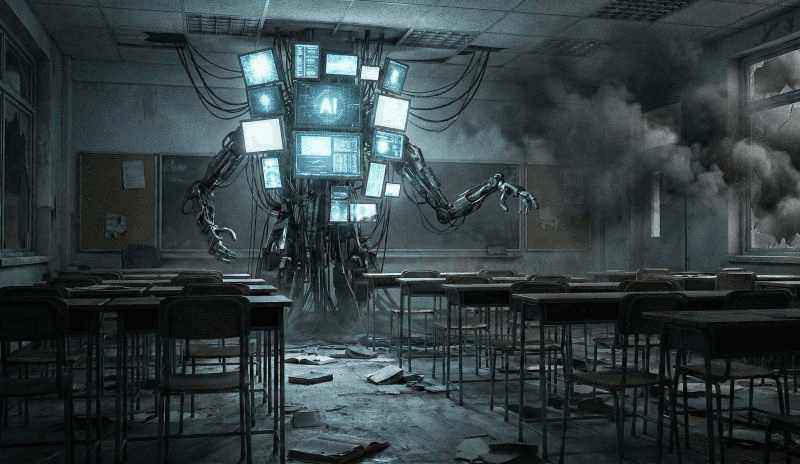
In a rapidly changing world, transformation must finally embrace a system that has so far remained almost untouched – education. Most schools still rely on outdated methods, ill-suited to the reality in which the young generation is growing up. Students increasingly succumb to the convenience offered by artificial intelligence, which, paradoxically, may lead to the neglect of one of the key competencies of the future: critical thinking.
According to the 2023 PARP report, already back then 48% of students used AI for learning, and 40% for doing homework. Importantly, educators are also opening up to new technologies. According to The State of Teaching (TALIS 2024) report, Poland ranks 5th in Europe in terms of AI usage by teachers. They most often use artificial intelligence to support exploring specific topics (65%) and generating lesson plans (64%). Interestingly, they use it least frequently for checking assignments and grading (26%) – that is, the most repetitive and tedious activities.
The right direction is not merely "using tools," but implementing the Human + AI Collaboration model. This requires a fundamental shift in approach: introducing subjects that genuinely prepare for upcoming challenges and using AI to personalize learning. The key is synergy – close cooperation of the teacher and student with technology. Without broadening horizons, the market and social role of the school will be called into question. If the system does not integrate with technology, the unique role of the teacher in shaping young people may be overshadowed by algorithms, which would be a huge loss for this crucial profession.
Elon Musk also reflects on the future of education. In a conversation with Peter Diamandis, he predicts that schools face a revolution in which personalized AI will take over the role of the "most patient teacher," adapted to the pace of every student. A key pillar of change should be gamification, thanks to which acquiring knowledge will become engaging and almost "addictive" in a positive sense. The teacher is to remain a mentor, yet without adapting AI (and later ASI – artificial superintelligence), technology may completely dominate the teaching process.
It is encouraging that more and more initiatives are emerging, such as the STEAM method. In this model, the student, instead of unreflectively absorbing information, adopts the attitude of an explorer and constructor, building knowledge through experience.
The future of education does not have to be a clash between humans and technology. It is an evolution in which intelligent tools lift the burden of routine from us, allowing the school to return to its roots: igniting passion, shaping characters, and jointly discovering the world.