Date
11.12.2018
Author
PulsBiznesu
The listed company reached an agreement at an express pace with banks, bondholders, and factoring providers. It has until the spring of 2020 to repay its debts. It can now focus on work.
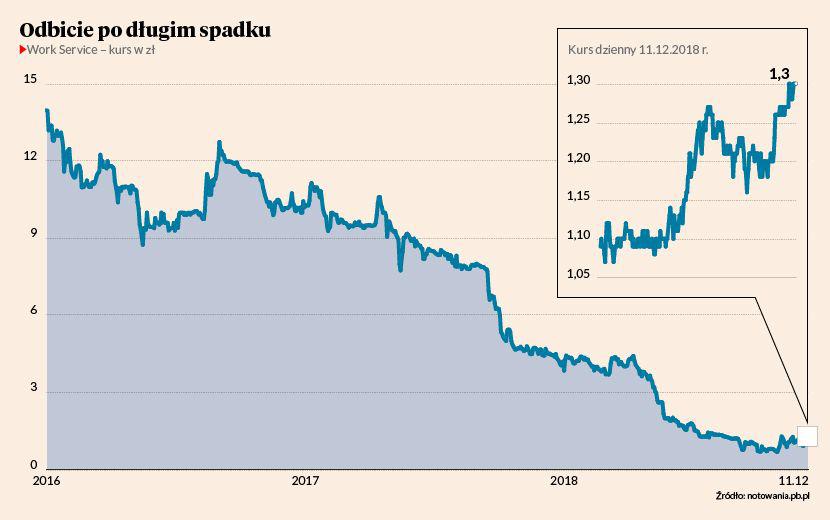
There will be no collapse; there will be a second life—at least for the next dozen or so months. On Monday, after six weeks of very intense negotiations with numerous creditors, the listed temporary employment agency Work Service reached an agreement with all parties, repaid part of its debts thanks to funds obtained from major shareholders, and rolled over the rest of the debt (details in the box). The result? Good spirits among the management board, which conducted negotiations and finalized details until the very last moment.
"This is probably the largest and fastest debt restructuring in the history of Poland. It was successfully carried out in six weeks, and it was not easy, because we had to align old and new factors, our lending banks, as well as institutional and individual bondholders. We succeeded, and now, as a group, we can finally focus on business development," says Maciej Witucki, President of Work Service.
At the Last Minute
Problems with excessive debt were not new, however, and the fact that bond series were maturing at the turn of November and December of this year had been known since their issuance. So why did the company restructure its debt at the last minute?
"We had been conducting the debt refinancing process for over a year. Various scenarios were at play; even in the summer, we held talks in London with potential investors who could take over the group's entire debt. However, this scenario was not realized, similar to the scenario of acquiring new lending banks in Poland, mainly due to the prolonged sale process of Exact Systems. All parties waited with final decisions until the closing of this transaction, which only happened at the end of October," says Maciej Witucki.
Exact Systems was put up for sale over a year ago. In November 2017, in "Puls Biznesu", the President of Work Service announced that the transaction could be closed within 6-9 months at a valuation exceeding 10 times EBITDA (which would mean a company value of over PLN 350 million), and the money obtained from it would allow for total debt repayment, and "all fears about loss of liquidity, which covered the company's image, will be forgotten." However, this did not happen: ultimately, Exact Systems was bought by Paweł Gos and Lesław Walaszczyk with the support of CVI Dom Maklerski, who agreed to pay nearly PLN 140 million. PLN 104 million from this transaction went immediately to the banks lending to Work Service, just under PLN 23 million went to Work Service's accounts, and PLN 13 million was to be transferred within 9 months.
"The sale of Exact Systems was a complicated process; we conducted advanced negotiations with three potential investors, some of whom tried to lower the price until the last moment, exploiting the difficult circumstances in which the company found itself. Its closing allowed for the commencement of bank debt restructuring and the rollover of bonds, and the last payment—which was initially supposed to go straight to the banks—has already hit the company's accounts after a deduction of PLN 2.3 million, allowing us to limit risk and improve the group's liquidity," explains Maciej Witucki.
Foreign Divestment
Now Work Service has until the end of March 2020 to repay bank loans and until May to repay bondholders. In total, this amounts to approximately PLN 150 million. Money for this purpose is to be found through the sale of other subsidiaries.
"This primarily involves the sale of the Hungarian company Prohuman. We have already started the process of selecting an advisor and are agreeing on details with the minority shareholder, who holds slightly below 20 percent of shares. After concluding these talks, we should carry out the transaction within a year, and the proceeds from it, according to independent valuations commissioned by us, should allow for the repayment of the debt in full," says Maciej Witucki.
The terms of the new bond issuance also included the possibility of selling subsidiaries in the Czech Republic and Slovakia.
"We foresee such a possibility, but our goal is to keep these companies in the group. We would not want to sell them," says Maciej Witucki.
Excessive Aggression
When Maciej Witucki came to Work Service at the end of 2015, together with the main shareholders—Tomasz Misiak and Tomasz Hanczarek—he announced the implementation of a strategy envisaging EUR 1 billion in turnover and foreign expansion. However, the ambitious plans were not realized.
"The strategy was very aggressive. It was based on acquisitions in the country and abroad, financed by capital, but also to a large extent by debt. The business model would only add up provided that all acquired companies were successfully integrated, which, however, did not happen," says Maciej Witucki.
The Management Board of Work Service now admits that there were two problems with foreign acquisitions—one in Hungary and the other in Germany.
"In Hungary, the company purchase agreement provided for earn-outs for existing shareholders, which turned out to be too high, and unfortunately, their scale was not limited by any clause. It was not foreseen that the company would grow so fast—as a result, earn-out liabilities in our books grew to the level of PLN 80 million," says Maciej Witucki.
In Germany, at the beginning of 2014, Work Service took control of the HR company of the logistics group Fiege for just under PLN 30 million.
"At the time of purchase, this business was profitable, but after the first year it broke even, and then losses began, which had a very negative impact on our debt ratios. In Germany, the business structure was based on one client; we are still working there on healing and diversifying the business," says Tomasz Ślęzak, Vice President of Work Service.
Back to Business
The temporary employment agency fell into trouble at a time when the economic climate is most favorable to it—the demand for employees is high both in Poland and in other markets.
"After concluding talks with banks and bondholders, we are immediately moving to talks with business partners; in our order book for next year, there are already 2.5 thousand employees whom we will bring not only from Ukraine but also from the Philippines or Vietnam, not to mention the professional activation of Poles," says Maciej Witucki.
After three quarters of this year, Work Service had PLN 1.57 billion in revenue (0.6 percent more than a year earlier) and a PLN 4 million loss at the EBITDA level.
"We expect that after the departure of Exact Systems and the Hungarian company from the group, next year we will be able to generate revenues at the level of PLN 1.3-1.5 billion," says the President of Work Service.
One Must Pay for Expansion
Work Service, which buckled under the weight of debts incurred for aggressive foreign expansion, is the latest example in a series of listed companies that heated up investors with announcements of international business development, and then disappointed them. At the end of November, we extensively described the history of Ursus, which was held up as an example of successful expansion of a Polish company in Africa and which announced, among other things, development in the electromobility segment. For now, however, the company has shown very poor financial results, entered into accelerated arrangement proceedings, and intends to sell part of its assets to implement a recovery plan.
The ambitious plans of Integer.pl, which was supposed to build a European network of several thousand parcel lockers, also ended in great disappointment on the stock exchange. Investors included the PineBridge fund (which also invested in Work Service), and Integer's stock price climbed dynamically. However, results did not follow, and parcel lockers set up outside of Poland did not achieve profitability. The Polish company's parcel locker network experienced significant turbulence at the beginning of 2017 in connection with Integer's problems with debt servicing and raising capital for development. This ended with the company being delisted from the stock exchange by the Advent fund, acting in agreement with Rafał Brzoska.
Outside the stock exchange, Pesa disappointed on a larger scale; a few years ago it won many contracts on the German market (for which it did not have homologation), while simultaneously fulfilling numerous orders for the Polish market. As a result, the champion became a supplier of emergency vehicles, with which many customers were dissatisfied, and banks refused further financing to the company. A vision of bankruptcy appeared, from which Pesa could be saved by an investor. Among potential candidates were foreign players; ultimately, the Polish Development Fund invested. An agreement was reached with German recipients.
Express Restructuring
At the end of November and the beginning of December, the redemption deadline for three series of Work Service bonds with a total value of nearly PLN 45 million expired. At the same time, the repayment deadline for loans taken in 2015 from a consortium of banks (Santander, Millennium, BGŻ BNP Paribas, and also PKO BP) was expiring, which—after the repayment of PLN 104 million obtained from the sale of Exact Systems—amounted to over PLN 110 million. Work Service wanted to roll over the bonds and postpone the loan repayment date. To do this, it first had to obtain confirmation from factors that they would make factoring lines worth at least PLN 55 million available. Such confirmation was obtained on Monday. Secondly, it was necessary to reach an agreement with bondholders. Tomasz Misiak and Tomasz Hanczarek, the leading shareholders of Work Service, put up PLN 7 million in cash for new bonds. With this money, individual bondholders and some institutions were paid off (and the new securities are in return privileged in terms of satisfaction priority). The rest of the bonds were rolled over, and incidentally, clauses regarding financial ratios, the breach of which would entitle bondholders to demand early redemption of securities, disappeared from the issuance terms. The redemption date for the new bond series is May 29, 2020. Earlier, by the end of March 2020, bank loans are to be repaid.
"In most restructuring processes in which companies, consulting firms, banks, and lawyers participate, meeting the challenge of combining different groups of creditors takes 6-12 months. Here, it was managed in a month and a half. This is not only a substantive but also a logistical world championship," believes Michał Lewczuk from PwC, who advised Work Service.