Date
7.01.2026
Author
Tomasz Misiak
The world has accelerated to the point where classic business profitability calculations are beginning to resemble reading tea leaves.
The pace of technological change—especially in AI—means that investment decisions today are burdened with a level of unpredictability we have never dealt with before. And we are not talking about startups or experiments, but about investments measured in billions of euros.
On behalf of Euvic, I am currently participating in talks regarding the Giga AI Factory. This is potentially the first true AI factory in Poland: an infrastructure of approximately 100,000 chips, initially based on NVIDIA Blackwells, with an amortization horizon of five years. The project only makes sense if the state, private capital, and the largest companies are able to act together and quickly.
The Arrival of Rubin
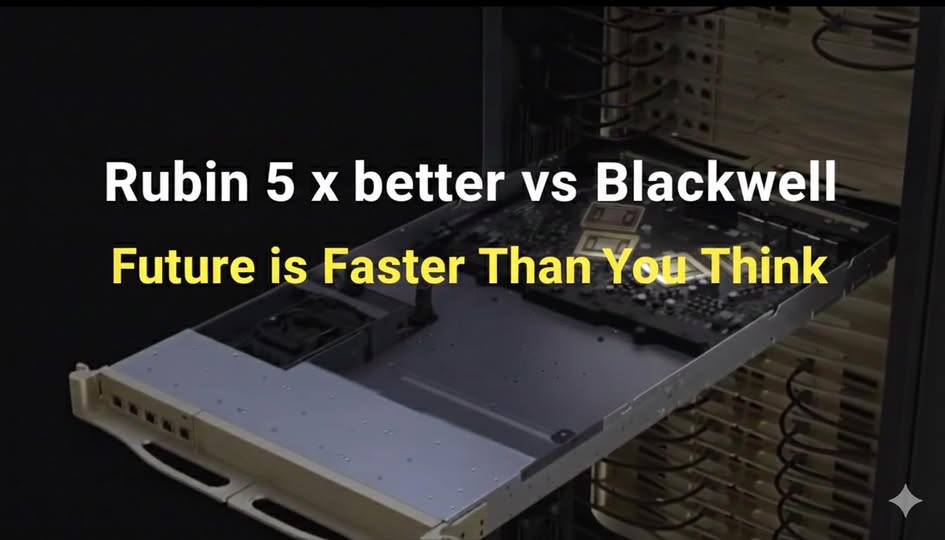
And at this very moment, Rubin enters the market. This is a chip that, according to announcements, is several times more cost-effective, consumes less energy, and performs inference up to 10× more efficiently. Differences that under normal conditions would be an evolution are becoming a revolution in the midst of building a revolution.
Consider these additional factors:
Average wait time for complete infrastructure: approximately 12 months.
USA–China geopolitics.
Attempts to open chip exports to China and their immediate blockades by Beijing.
The fact that in the race between superpowers, price does not matter—only the advantage counts.
Strategic Game vs. Business Risk
For the USA or China, this is a strategic game. For Europe—and especially for Poland—it is a real business risk.
What if, by launching a multi-billion euro AI factory, we start competing with entities that enter the market 5× cheaper and technologically ahead? What if our investment is "state-of-the-art" only on the day the contract is signed?
This problem does not only concern AI. We see the same in:
Energy storage
Electromobility
Energy banks
Climate technologies
The innovation cycle is now so short that organizations—and nations—are failing to keep up.
The Luxury of Innovation
In my opinion, this is exactly what is behind Jensen Huang’s narrative toward the US administration: give them today's generation—tomorrow we will be several steps ahead anyway. The problem is that not everyone can afford such a luxury. In Europe, we must count every cent we spend.
We are standing on the threshold of a decade that will be more technologically intense than the last 100 years. The question is no longer whether to invest. The question is how to invest responsibly in a world that changes faster than the financial models used to describe it.
This is currently the most difficult challenge for leaders, investors, and governments.