Date
10.01.2026
Author
Tomasz Misiak
The media world hasn't changed suddenly. It has simply stopped pretending.
For decades, we lived under the conviction that information flows linearly. Editorial offices, studios, schedules, broadcast times. The viewer was expected to adapt. Psychologically, it was a parent-child model: the media knows best, and the audience listens. Even if they disagreed, they remained passive.
The Shift in Power
YouTube and X have reversed this relationship. The recipient doesn't just choose; they decide when, who, and for how long they listen. This is a fundamental psychological shift. We have moved from a hierarchical relationship to a partnership—and often to a brutally honest one, where the creator is tested every day.
X is no longer just a social platform. Elon Musk states directly that today it is number one when it comes to information searching. It is hard to argue with that—not because X always tells the truth, but because it reacts immediately. In situations of uncertainty, the human brain seeks speed, context, and emotion. Television offers stability; the internet offers a semblance of orientation in chaos, though it often creates it. In times of crisis, pace wins.
The Generational Gap
Added to this is a generational change that traditional media has completely failed to digest. We are entering an era of personalization of expectations.
Generation Z (and soon Alpha) will not consume media "for everyone."
They expect content tailored to them—in their language, pace, and format.
TikTok is not an entertainment platform for them; it is their primary interface for understanding the world.
It is defined by short forms, strong stimuli, fast narration, and immediate social verification.
Attention as Authority
Linear television operates on 20th-century mechanisms: background watching, studio authority, and repeatability of the message. Psychologically, this is a world of low engagement and high inertia. YouTube, X, and TikTok work the opposite way. A click is a decision. A decision means attention, and attention means power.
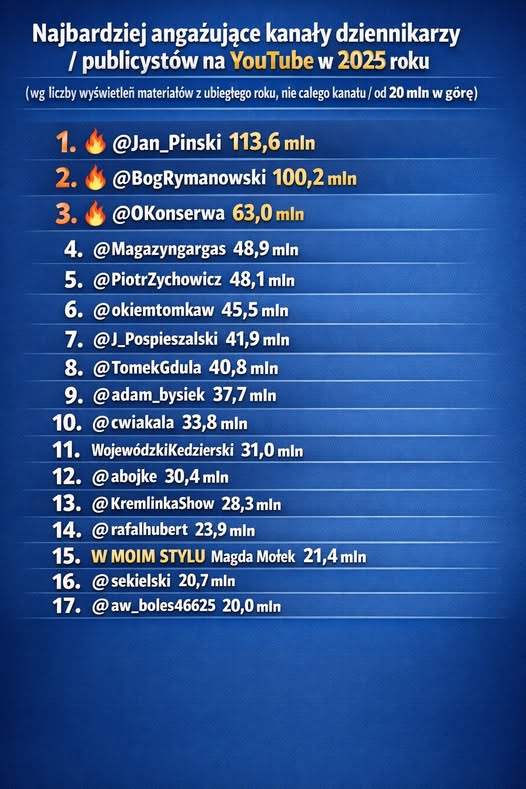
That is why Jan Piński’s 113 million views are a multiple of the annual prime-time audience of TVP Info. This is not a metaphor; it is a factual change of scale.
The Case of "Kanał Zero"
The phenomenon of Kanał Zero is a perfect case study. It is not just a channel; it is a new type of medium—a hybrid of an editorial office, a community, and an opinion distribution platform. People don't go there for "objective truth." They come for an interpretation of the world by people they know, understand, and can argue with. It is an adult relationship, not an educational one; it is often non-objective and author-driven.
What Lies Ahead?
We are facing the further atomization of authority. Instead of a few large transmitters, we will have hundreds of strong opinion nodes. Media will become:
More personal
More emotional
More accountable (because a mistake costs you instantly)
Television will not disappear, but it will cease to be the point of reference. Public opinion will no longer be "shaped"—it will self-organize.
This is a change that cannot be undone.