Date
3.01.2026
Author
Tomasz Misiak
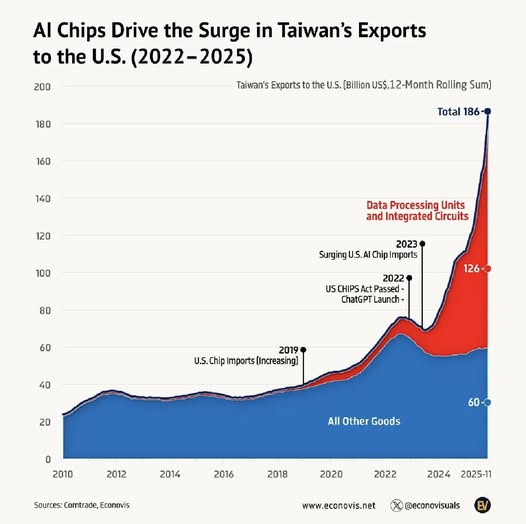
When I read Chip War, one thought struck me: in the 21st century, wars do not start with tanks, but with chips. I return to this thesis looking at the data showing the explosion of semiconductor exports from Taiwan to the USA between 2022 and 2025. This is not just a regular business cycle. It is a geopolitical alarm.
The Global "Single Point of Failure"
Taiwan has become the "single point of failure" of the global economy. Approximately 90% of the most advanced chips are manufactured there. Without them, there is no AI, no modern military, no cars, no energy sector, and no technological advantage. In practice: whoever controls Taiwan has their hand on the pulse of the world.
The American and European Response
Why is the USA reacting so nervously? Because, for the first time in decades, it has realized that the free market does not guarantee national security. The CHIPS Act, billions in subsidies, and pressure on TSMC to build factories in Arizona do not stem from a trend for "reshoring." It is a response to real fear: a single crisis in the Taiwan Strait could paralyze the American economy faster than any recession.
Europe thinks similarly, though it acts more slowly. Brussels knows that without its own semiconductor production, the Old Continent will remain a digital colony—technologically, militarily, and economically dependent. Hence the European Chips Act, investments in Germany, France, and the Netherlands, and nervous negotiations with Asia.
The Ambitions of China
And China? Beijing does not hide its ambitions. For them, Taiwan is not just a "renegade province," but the key to technological sovereignty. Most serious think tanks—from CSIS to RAND—agree on one thing: the risk of escalation is growing, although a full-scale invasion scenario is not the most likely today. More realistic is long-term pressure: blockades, cyberattacks, and economic and political destabilization.
The Shield of Importance
Is Taiwan under threat? Yes. Is war inevitable? No. Paradoxically, the significance of chips acts as a shield today. Taiwan is "too important to fail," but simultaneously "too important to remain without an alternative."
This is why the world is building factories outside of Taiwan. Not to replace it, but to reduce systemic risk. This is a lesson for every business leader: concentration may be efficient, but only diversification provides resilience.
We are entering an era where geopolitics meets risk management. Chips are the new oil. Those who do not understand this will wake up in a world where political decisions in Asia dictate their financial results in Europe.