Date
06.02.2026
Author
Tomasz Misiak
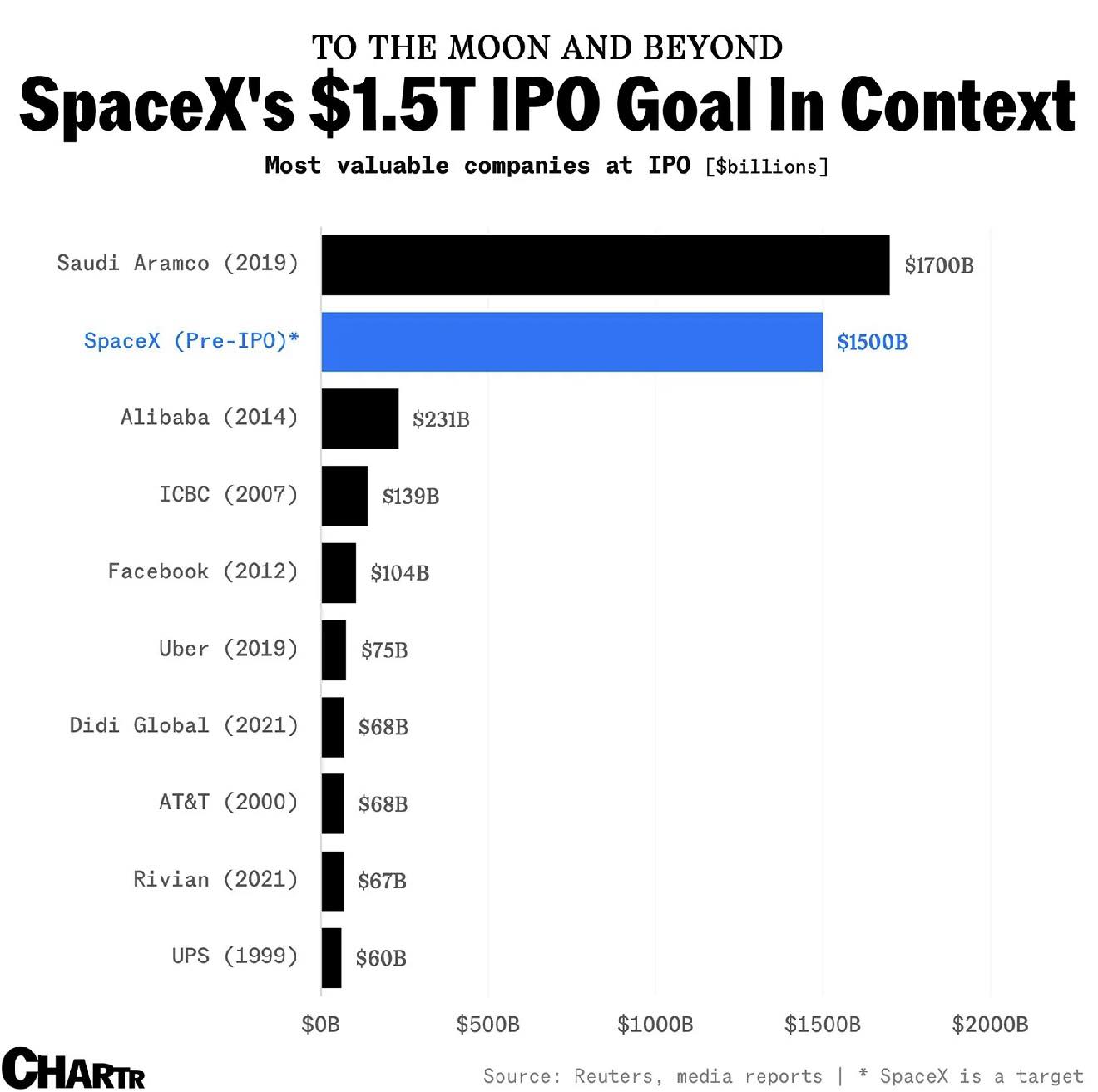
"Valuation madness" is perhaps how one could describe SpaceX's IPO plans, which value the company at a pre-IPO level of $1.5 trillion. For comparison, that is 150% of the GDP of Poland, a country that prides itself on recently becoming the 20th largest economy in the world.
I will likely soon hear voices saying that GDP should not be compared to valuation because they are different metrics. Nevertheless, if SpaceX were to sell 20% of its shares, the cash it would obtain would be greater than our country's entire annual budget.
Additionally, SpaceX is reaching the valuation of the largest IPO in history: Saudi Aramco. As a reminder, Amazon had a valuation of $438 million at its IPO.
What is behind such a valuation for SpaceX? First, the merger with xAI, valued at approximately $250 billion, and $1 trillion for SpaceX—representing Musk's full power in AI, together with Grok, Colossus, and plans to conquer this market.
Second, Starlink, along with the newly announced mobile phone access system—one subscription across the entire globe. Added to this are contracts with NASA and plans for the colonization of the Moon and Mars.
Of course, one cannot forget Starship and the revolution of the multi-planetary nature of the human species.
Is this valuation high? In relation to the results achieved—$8 billion in revenue and approximately $1.5 billion in losses for xAI—yes, this valuation is astronomical. It is about 200 times forward earnings. Unattainable in any other sector and on any other market.
Why? Musk is not selling rockets alone. He sells dreams of the future—of a new world, of humanoid robots, of colonies. He sells us what each of us absorbed as children in the books of Asimov, Lem, and Harrison. That which drove the 20th century—the belief that humanity's technology has no limits.
Who is buying? Mainly the wealthy, for whom the end justifies the means. Spending even 20% of one's income to fulfill dreams is not a cost—it is fulfillment.
Musk delivers even in chaos: Starlinks work, rockets land again, robots are making giant progress, and Starship has replaced Star Trek—only in real life.
What next? Will it be like Facebook—where the IPO turns out to be a short-term flop but a long-term success? I think so.
Humanity is currently in the best period of its history, in a time of changes such as we have never experienced before. Technology may transform us into beings that our ancestors would have considered gods.