Date
20.12.2025
Author
Tomasz Misiak
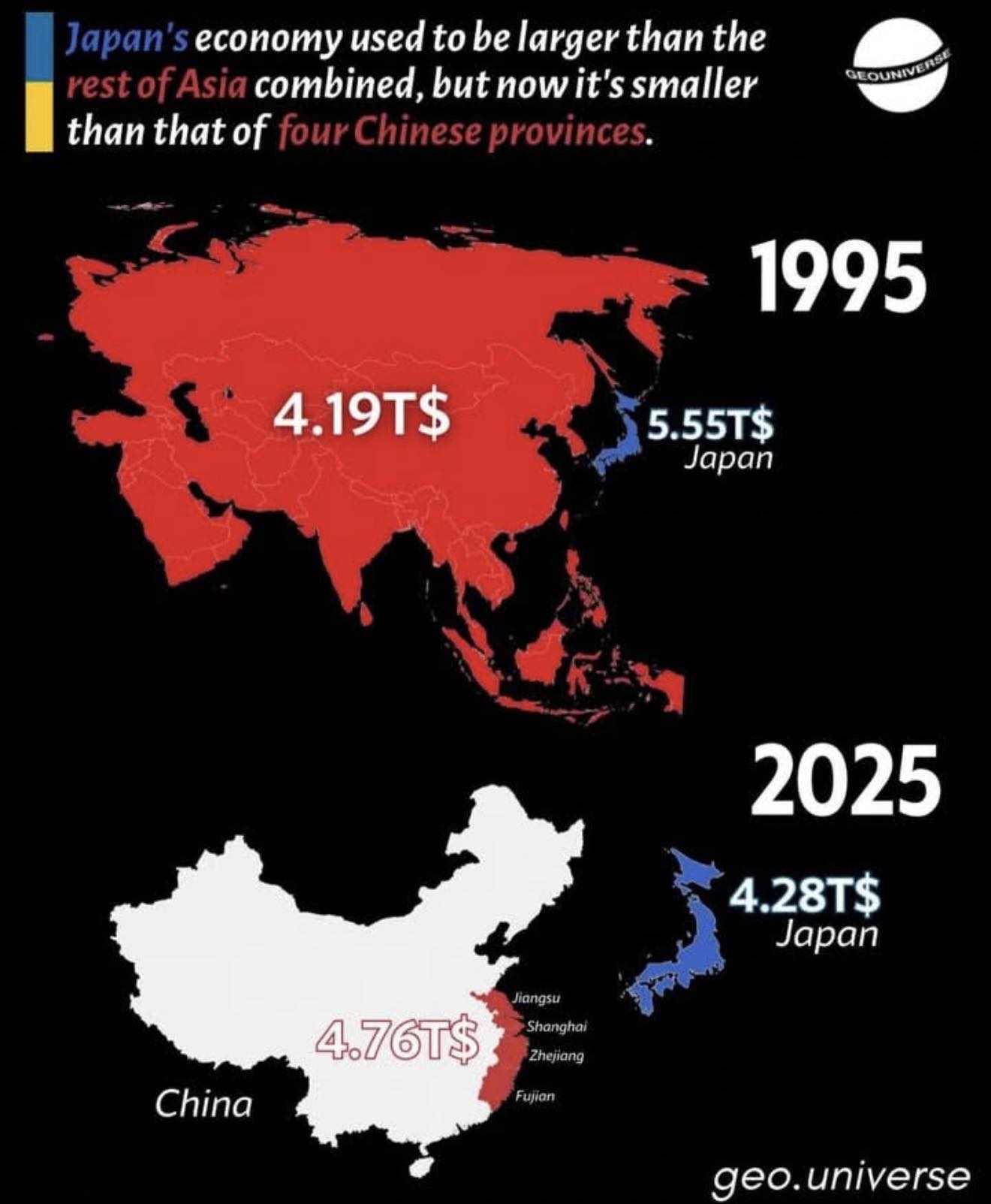
Ah, Japan! Once the "Empress of Asia," with a 1995 GDP of $5.55 trillion—larger than the rest of the continent combined ($4.19 trillion). Today, in 2025, just four Chinese provinces—Guangdong, Jiangsu, Zhejiang, and Fujian—are worth $4.76 trillion on their own, while Japan is barely hitting $4.28 trillion. How did a global giant become a laggard? It’s a story of how success can breed complacency.
I remember the 1980s when the world envied the Japanese: Toyota, Sony, and the massive tech boom. But after the speculative bubble burst in 1990, they fell into a trap. Three "lost decades" followed—deflation, stagnation, zero interest rates, and quantitative easing that failed to bridge the gaps. The reason? A rigid, ossified structure: the older generation blocks the path for the young in both politics and business. The society is aging rapidly—with a fertility rate below 1.2, it is one of the oldest in the world. Public debt has reached 260% of GDP, coupled with low productivity and a lack of innovation. In the midst of wealth, it is easy to forget about the necessity of reforms.
Now, something is finally stirring: inflation is above 2%, wages are rising, and the stock market is hitting record highs. However, the 2025 forecast remains a modest 0.9–1.0% growth while the rest of the world races ahead. Is it too late? Experts from AMRO and Deloitte say no—but only if they take decisive action:
Opening to immigration to rejuvenate the workforce.
Labor market reforms to provide more flexibility for startups and women.
Investments in AI and green energy.
Debt reduction through higher taxes for the wealthy and cutting waste.
And what about Poland? We boast about catching up to them in GDP per capita (PPP): our $55k vs. their $54k. We are still behind in nominal terms, but our 3.2–3.5% growth rate beats theirs by a landslide. I am proud because we emerged from post-communism using the "Japanese model": exports, discipline, and education. But is that model still enough? We are facing the middle-income trap. Our society is aging (fertility at 1.3), debt is growing (50% of GDP), and we remain heavily dependent on exports to Germany.
I look at South Korea with envy. In 2025, they are growing at 0.9–1.9%, but since the 90s, their GDP has grown tenfold! This is thanks to relentless innovation—Samsung, Hyundai—and spending 4.5% of GDP on R&D. They are younger (though also aging) and supported by pro-immigration policies. Their GDP stands at $1.7 trillion, and their per capita wealth is already higher than ours.
To avoid Japan’s fate, Poland must act now:
Demographics: Tax breaks for families, more nurseries, and smart immigration from Ukraine or Asia.
Innovation: A goal of 3% GDP for R&D and support for startups.
Education: Reforming the system for AI and the green economy.
Stability: Keeping inflation in check without stifling growth.
Diversification: Expanding export markets beyond our current reach.
The lesson from Japan? Success is not eternal. We must act before we find ourselves as the "laggards of Europe" in 30 years. Because nothing is given once and for all.