Date
2.01.2026
Author
Tomasz Misiak
If we consider language to be one of the key indicators of cultural and civilizational dominance, there is little doubt that Great Britain—during its prime—built a massive potential for development. This is especially true given that the baton of global promoter of the English language, Anglo-Saxon law, and cultural patterns was taken over by the hegemon of the 20th and 21st centuries: the United States.
Language as the Infrastructure of Development
Why has language dominance always been so important? The answer is simple: a shared understanding and application of law, uniformity in institutional solutions and trade contracts, the speed of communication, and the reduction of friction in economic relations. Language is the infrastructure of development.
To this day, former colonial powers derive tangible benefits from this legacy:
Great Britain in India.
Spain in South America.
Portugal in Brazil.
France in Francophone African countries.
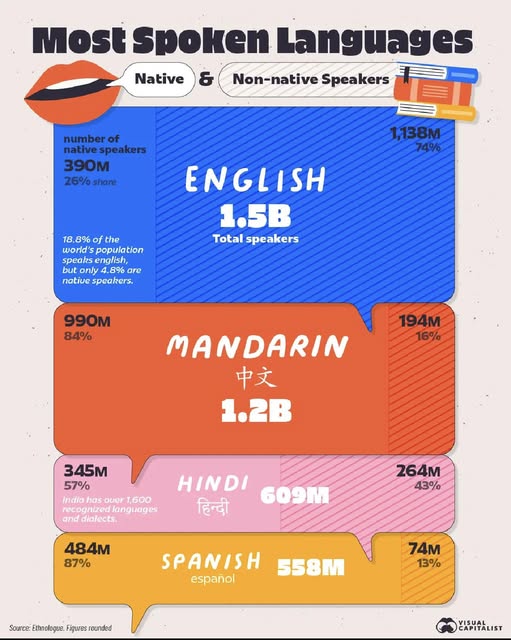
Language solidifies trade, political, and relational influences for decades. The British Commonwealth was the empire "on which the sun never set"—and historical charts clearly show who the greatest power truly was.
What Comes Next in the Era of AI?
Today, Apple and Google already offer live translations. Soon, business communication with someone who does not speak our language will become trivial—instantaneous, fluid, and preserving the speaker's tone, timbre, and emotions. This will lead to a massive democratization of global business.
If language ceases to be a barrier, countries where the education system did not allow for mass foreign language learning gain a real chance to close the gap. While it is difficult to calculate the exact percentage increase in influence today, it will certainly not be marginal.
The Motivation to Learn
This raises another question: how will AI affect the motivation to learn foreign languages? If we can understand everything perfectly in any language, why bother learning? Perhaps the reason will be to understand culture, context, and nuances that an algorithm can never fully capture.
It is also important to remember that AI is not culturally neutral. Language models are trained on data—in specific languages with specific cultural influences. It is no coincidence that the world's largest language groups today are Mandarin (China) and English (USA/UK), and it is there that global powers clash.
The Polish Context and Technological Sovereignty
An interesting point: it is increasingly heard that the Polish language—thanks to its precision and lack of ambiguity—can be easier for AI to interpret than English. This makes it all the more important to support local models, such as Bielik, to avoid losing potential and to build our own independence and technological sovereignty.
We may not see Poland on historical charts of colonial power. However, let us ensure we appear on another one: the one that measures AI influence, the level of adoption, and the real-world utilization of technology across the entire population.