Date
3.01.2026
Author
Tomasz Misiak
The world loves novelty. So does capital. We are fascinated by digital assets, technological giants, the promise of unlimited scale, and the narrative of the "new economy." At the same time, for years, gold has stood quietly at the very top of the list of the world's most valuable assets—unshaken, without marketing, pitch decks, or press conferences.
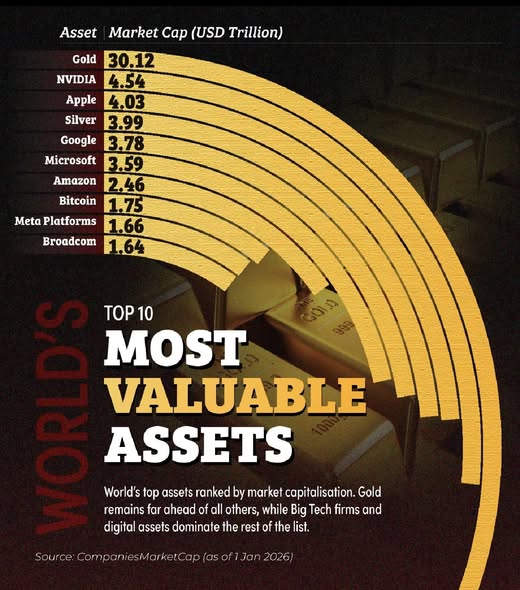
Gold's capitalization today is approximately $30 trillion. That is roughly half the capitalization of the entire American stock market. It is more than any single company, technology, or digital asset. Interestingly, documented oil reserves theoretically have even three times the value of the gold held in global reserves. And yet, it is gold that serves as the global point of reference.
Why?
We increasingly trust digital assets, the companies behind digitalization, and soon, new forms of money—like the digital dollar. The logic of this faith is simple: efficiency, scale, speed. The problem is that most of these assets can be mass-produced. Code, tokens, models, platforms—all of them can be replicated with almost no marginal cost. And mass supply, sooner or later, leads to the erosion of value.
Gold works in the opposite way. It is:
Limited and physical.
Costly to mine.
Resistant to creative accounting and the political decisions of central banks.
It cannot be "printed." It cannot be replicated with a single click. It cannot be updated to version 3.0.
The Lack of Constants in Technology
In the world of technology, there are no constants. Today's giants may be marginal tomorrow. Google, Meta, even OpenAI—they frequently trigger "red alerts" in response to threats to their business models. Regulations, competition, and technological breakthroughs can turn a leader into a defender in just a few quarters. In the digital world, the barrier to entry is systematically decreasing, and competitive advantages are shortening their expiration dates.
The dollar may devalue. Stocks can lose half their value. Cryptocurrencies can change valuations by dozens of percent in a week. Through all of this, gold remains the reference point. It is the asset people return to in moments of uncertainty, geopolitical tension, debt crises, and loss of trust in institutions.
Current Drivers for Gold
Specific arguments for the rise in gold prices today are very concrete:
Record purchases of gold by central banks, especially outside the Western world.
Rising national debt and pressure to maintain real negative interest rates.
Fragmentation of the global economy and a decline in trust in a single monetary center.
Demographics and long-term inflationary pressure.
Of course, the future may bring changes—extraterrestrial mining, new material technologies, or breakthroughs that sound like science fiction today. For now, however, they remain just that: SF.
Those who keep their feet firmly on the ground treat gold not as a speculation, but as a value-storing asset. It is an anchor in a world that is drifting faster and faster.