Insights
Bohr was right – prediction is difficult. Especially about the future.
Date
19.12.2025
Author
Tomasz Misiak
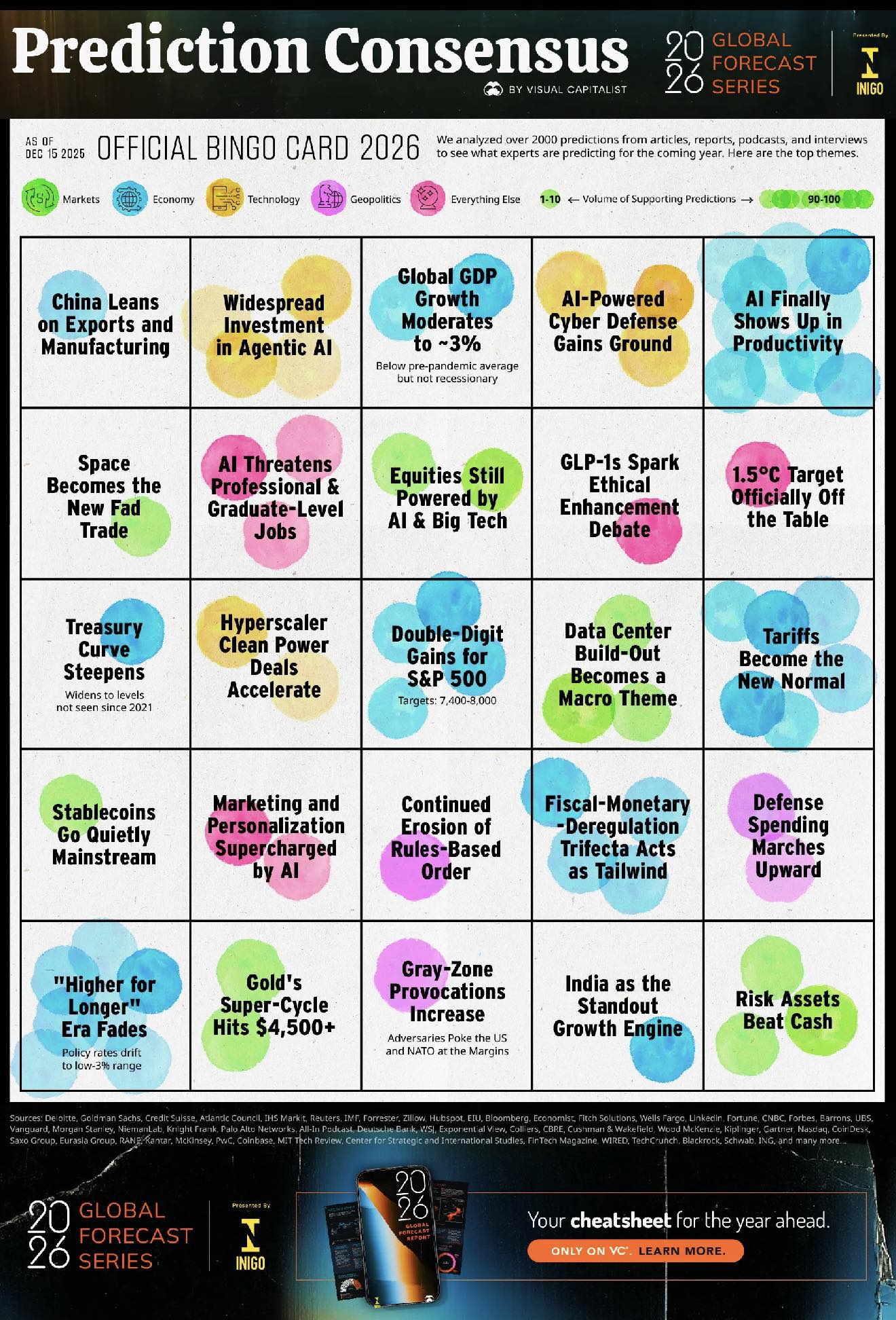
And yet, every year, the worlds of finance, technology, and politics engage in a collective ritual of forecasting. It’s not because we believe in the infallibility of these predictions. Rather, it’s because a map of trends helps us make better decisions here and now. Looking at this year’s "consensus predictions," several clear axes emerge that will define 2026.
First: AI enters its "adult" phase. It’s no longer about hype; it’s about productivity. AI is finally expected to "show up in the bottom line," automating marketing, personalization, cybersecurity, and knowledge processes. At the same time, a darker side appears: pressure on professional and entry-level roles. Agentic AI is not an experiment—it is a new layer of work organization.
Second: Infrastructure wins over narrative. Data centers as a macro theme, hyperscalers signing long-term clean energy contracts, and steady Big Tech growth. This isn't a bubble—it’s the construction of the backbone for the next decade of the digital economy.
Third: Geopolitics normalizes tension. Tariffs as the "new normal," China returning to aggressive exports and production, the erosion of the rules-based order, and gray-zone provocations against the US and NATO. Defense and security are no longer just costs—they have become a permanent line of growth.
Fourth: Money changes its tone but doesn't disappear. The yield curve is steepening, the "higher for longer" era is fading, and fiscal-monetary deregulation is starting to act as a tailwind for risk markets. Equities are beating cash, the S&P is aiming for further double-digit growth, and gold is flirting with levels that recently seemed like pure fantasy.
Fifth: The world seeks a new growth engine. India stands out as a structural winner. Stablecoins are quietly entering the mainstream. GLP-1 drugs are sparking not just a health revolution, but an ethical one. Meanwhile, the 1.5°C goal of the Paris Agreement is increasingly disappearing from the real decision-making table.
Ray Kurzweil said that the future doesn’t arrive linearly—it arrives exponentially. If so, the question isn’t if these predictions will come true, but who will be ready for them.
The strategy for today? Less guessing. More building competence, resilience, and options. The future will surprise us regardless. The difference lies in whether we will be among the startled—or the prepared.